1 Introduction
- Opinions are equivalent to beliefs or attitudes: they are theoretical constructions hypothesized to affect behavior, but need not be based on evidence or experience, but hearsay from others.
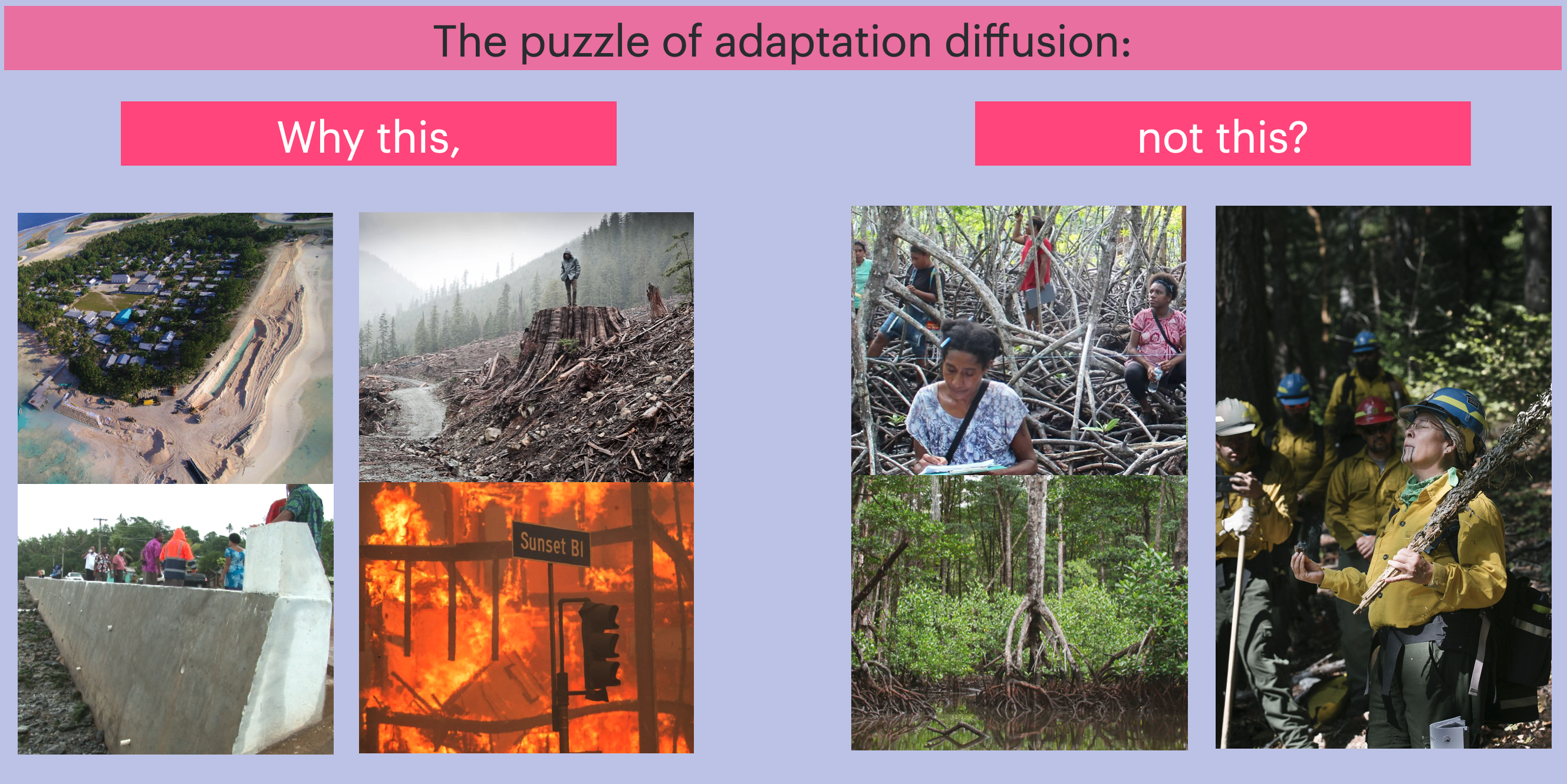
- Polarization and extremism incapacitate the institutions responsible for forest and coastline management, to name two examples. In forest management, we know prescribed burns could prevent catastrophic wildfires (Eisenberg et al. 2019; Kolden 2019). So although we have Indigenous practices for climate action (SDG 13) and the protection of Life on Land (SDG 15) they are ignored in favor of maladaptive modern practices. These traditional practices have helped historically local inhabitants over thousands of years, and they can still help now.
- Opinion science, then, can help us answer the primary puzzle of sustainable adaptation: why do maladaptive, unsustainable practices take hold and not adaptive, sustainable ones Figure 1?
2 Models
- Models of opinion change began with DeGroot (1974) who developed a model that calculates the final opinion of a group given initial opinions and the social network representing who interacts with whom.
- We call this model of opinion change in DeGroot’s model simple consensus. In this model process, two people interacting will both come to have the mean of their initial opinions. People don’t ignore each other, they don’t cause others to be repulsed becoming more oppositely extreme, and people are all equally stubborn. The model social groups DeGroot simulated with his model were small, with ad hoc social network choices, not motivated by specific empirical questions. This is perfectly fine, the normal course of science. DeGroot’s paper provided the impulse and the theoretical foundations that modern opinion science models have expanded on to include richer representations of real-world social influence processes.
- Opinion change became progressively more complex over the years. Some of the first opinion change models in the decades following DeGroot assumed social influence could either lead to
- Greater consensus if the people interacting are similar enough.
- People ignore each other if they are too different.
- Continuing to build, Macy et al. (2003) operationalized consensus, gradual ignorance increase with opinion distance, and opinion repulsion where people become even more opposed to one another in their opinions following an interaction.
- Modern opinion dynamics models are mostly generative, with different types serving different purposes. Many problems in opinion science were articulated about the same time as computing power became widely available enough for scientists to be able to use agent-based modeling en masse.
- It does seem like there exist
3 Measurement
- In this lecture we focus on measuring opinion change measured with survey responses.
- We’ll also review
3.1 Opinions
3.2 Opinion change
3.3 Surveys
3.4 Legacy opinion change measurement
3.5 Why this is a problem
3.6 Correct opinion change measurement
4 Case study: echo chamber radicalization (aka group polarization)
- We can use the models and measurement we learned so far to
- simulate echo chamber radicalization, which we will call group polarization because it’s shorter and that’s it’s name for social psychologists. But we tend to think of polarization as being when two opposing groups are extremely rigidly opposed to each other; some sociologists call this “bi-polarization” to differentiate the everyday layperson’s definition of “polarization” from what social psychologists called “group polarization”.
- show how we can estimate the false discovery rate and statistical power of hone experimental design to calculate the false discovery rate
5 Discussion
- I wanted to include sentiment analysis because it seems like it’s measuring something like an opinion if we analyze just one person’s speech or writing. But something tells me it needs to be worked out more.
References
DeGroot, Morris H. 1974. “Reaching a Consensus.” Journal of the American Statistical Association 69 (345): 118–21.
Eisenberg, Cristina, Christopher L. Anderson, Adam Collingwood, Robert Sissons, Christopher J. Dunn, Garrett W. Meigs, Dave E. Hibbs, et al. 2019. “Out of the Ashes: Ecological Resilience to Extreme Wildfire, Prescribed Burns, and Indigenous Burning in Ecosystems.” Frontiers in Ecology and Evolution 7 (November): 1–12. https://doi.org/10.3389/fevo.2019.00436.
Flache, Andreas, and Michael W. Macy. 2011. “Small Worlds and Cultural Polarization.” The Journal of Mathematical Sociology 35 (1-3): 146–76.
Hopfield, John J. 1982. “Neural networks and physical systems with emergent collective computational abilities.” Proceedings of the National Academy of Sciences of the United States of America 79 (8): 2554–58. https://doi.org/10.1073/pnas.79.8.2554.
Kolden, Crystal A. 2019. “We’re not doing enough prescribed fire in the western united states to mitigate wildfire risk.” Fire 2 (2): 1–10. https://doi.org/10.3390/fire2020030.
Macy, Michael W., James A. Kitts, Andreas Flache, and Stephen Benard. 2003. “Polarization in Dynamic Networks: A Hopfield Model of Emergent Structure.” Dynamic Social Network Modeling and Analysis, no. March: 162–73.