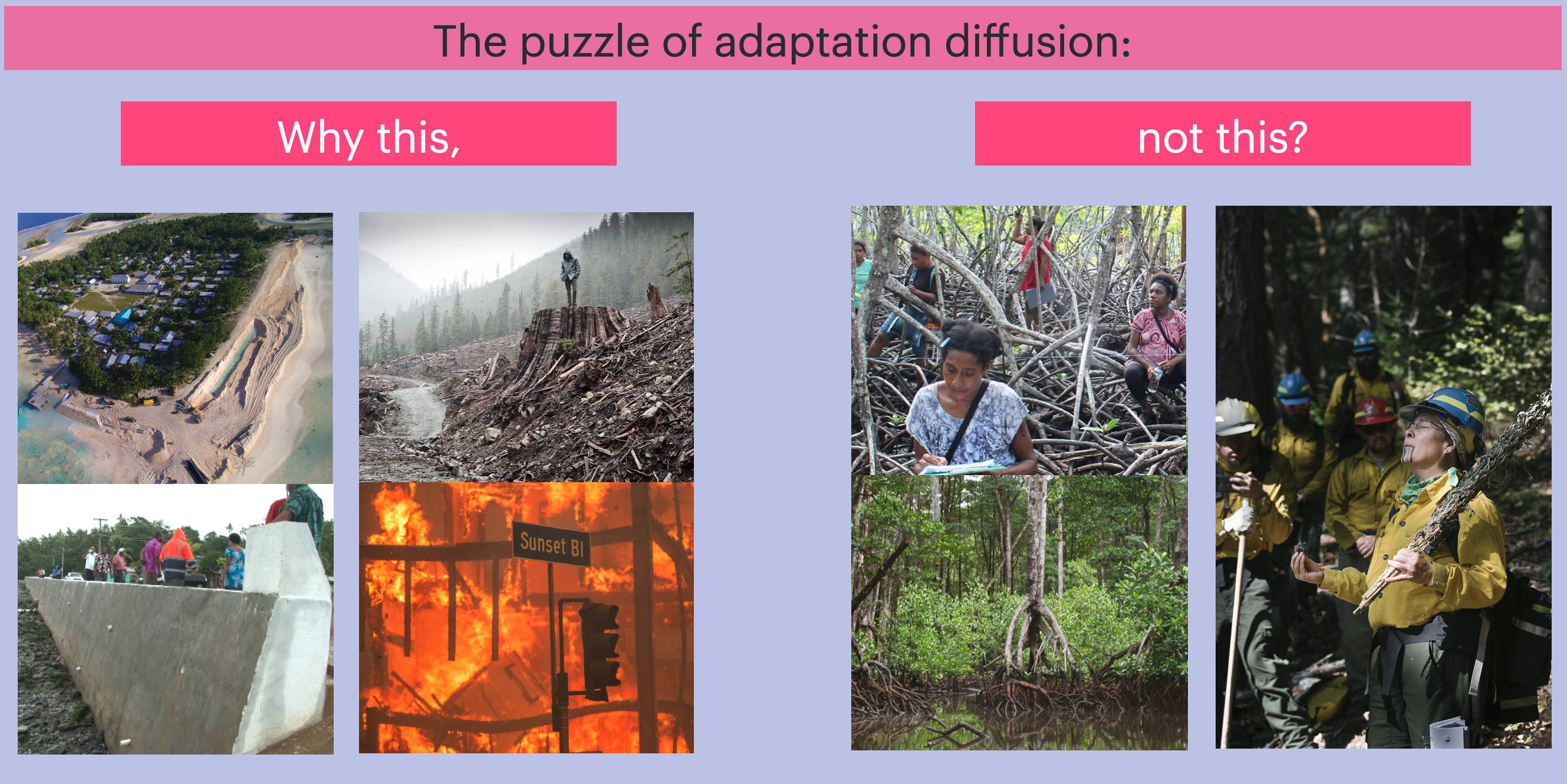
Humans know how to adapt to climate change. Indigenous, local peoples of the South Pacific Islands and other coastal habitats have sustainably managed mangrove forests to dissipate storm surges and prevent erosion, mitigating potential costs of climate change since long before the anthropocene (Alongi 2002; Nalau et al. 2018; Pearson, McNamara, and Nunn 2020; McNamara et al. 2020). First peoples of western North America have similarly practiced prescribed burns to prevent destructive wildfires during times of drought for millennia (Eisenberg et al. 2019; Kolden 2019).
Despite their effectiveness, adaptive practices like these often fail to spread widely. Instead, development agencies advocate for the construction of high-maintenance “grey infrastructure” like seawalls, even though seawalls can exacerbate flooding once breached (Piggott-McKellar et al. 2020). Inland forest management is beset by polarization among stakeholders (Swette, Huntsinger, and Lambin 2023), resulting in devastating wildfires burning a buildup of fuels or greenhouse gas-intensive clearcuts.
This is our puzzle (of adaptation—put down Sudoku ha): why do some reliably effective sustainable practices fail to diffuse broadly, but more costly ones do, often carrying more risk for more uncertain rewards (Figure 1.1)?
Ultimately our goal is to develop design principles for educational campaigns to promote viral sustainability. Achieving this requires we understand how behavior and opinions spread between people. Viral sustainability means that sustainable practices or attitudes continue to spread in a population following an educational campaign directly instructing a set of individuals I call the seed set.
What I call the seed set, or just seeds, are often called the targets who are targeted for direct instruction. For one notable example, Airoldi and Christakis (2024) in their study “target”ed residents of “176 villages in the isolated western highlands of Hondouras”! I prefer non-violent prose since our language shapes our thinking (Lakoff and Johnson 1980; Cibelli et al. 2016; Regier and Xu 2017).
To predict how different educational campaign strategies affect outcomes we can delineate four guiding questions:
- How do people decide what to do, i.e., how does learning work?
- How does identity affect social learning and influence?
- How do different social network structures affect adaptation diffusion?
- How to use computational modeling to deal with the complexity of social behavior?
The focus of this course is developing technical and domain expertise in social science that can help us simplify complex combinations of cognitive and social factors that affect whether sustainability “goes viral”.
Social Science for Sustainability
Social science is immensely broad and complex comprised of numerous traditional academic disciplines in their entirety, such as anthropology and sociology, with contributions from several other traditional disciplines, including cognitive science, engineering, and physics. We use the problem of promoting sustainable practices via interventions to structure this work. Sustainability interventions are eductaion campaigns to induce the diffusion of certain adaptive, sustainable behaviors, such as in public health (Airoldi and Christakis 2024), microfinance to support gender equality at work, home, and everywhere (O’Connor and Weatherall 2018; Clydesdale and Shah 2023), and climate change adaptation via ecosystem protection (Brooks et al. 2018; McNamara et al. 2020). Following the UN SDGs, we see that this is quite a broad range of potential behaviors, which is actually a good thing. It means that our conclusions could apply to a broad range of application domains.
On reflection, social science for sustainability needs a science of how adaptive, sustainable behaviors, opinions, and other socially-transmitted items diffuse from person to person, throughout a population, over time. I don’t know for sure, but it seems like this may be the fundamental problem in social science, broadly understood. The puzzle of adaptation frames the overarching question of designing interventions: how best to jump-start a self-sustaining process diffusing adaptive sustainable behaviors?
Computational social science is the use of mathematics and computers to understand and model the mechanisms underlying social diffusion phenomena, such as the adoption of sustainable practices or rising political extremism, and statistically analyze collective behavior data. We start here and for the first chapters of the book developing formal and generative models of promoting widespread behavior change. When we come to opinion change, we arrive at a natural transition point where theory necessarily meets practice to understand how to properly measure opinion change in the real world, which requires statistical inference since opinions are not directly measurable. We apply our techniques to show that
Computational social science is a cognitive gadget to help us use social science theory for reasoning about the effect of different cognitive capacities (e.g., adaptive social learning), social processes (e.g., rising extremism), and social and natural environment constraints (e.g., social networks, wildfire risk). Too often in the history of social science, social science theory is not presented mathematically, with squishy verbal explanations of theories and their consequences instead of concrete, rigorous mathematical or computational statements, where rigorous means they are theoretically true under a set of explicitly-specified assumptions. This means that mechanisms have tended to be only vaguely specified, and changes in assumptions cannot be quantitatively, let alone systematically, explored (Turner and Smaldino 2022).
The UN Sustainable Development Goals help us focus and organize our work by providing concrete goals for evaluating progress towards sustainable development for all Figure 1.2. These goals include targets for institutional development that promotes basic conditions for human thriving (justice, equality, education, public health, and no poverty) so as to assemble and enable a critical mass of people to participate bringing about sustainable development. People cannot participate in sustainability if they suffer in poverty, from illness, or subjugation by authoritarians–all but the most zealous environmental defenders will fight on when these basic needs are unmet. Since progress has been slower than necessary.
Sustainability, then, has several different dimensions, all of which contribute to climate action and environmental protection. I have organized these goals into the VIBE system to guide sustainability promotion where Vibrant Institutions meet the Basic needs, including Environmental and Ecological protection. The 17 goals and how they each help catch a VIBE are illustrated in Figure 1.2.
Organizing and connecting our work to has two benefits. First, it helps us identify which cognitive and social factors are at work in different sustainability foci. Second, it expands the corpus of existing research on which we draw to consolidate our social and cognitive theories of behavior change that we will apply to sustainability interventions. While many of us in computational social science know our work is important as basic science partly because we are confident it can apply to real-world problems, it is not clear how. Part of this problem seems to stem from the lack of a clear goal for this science beyond evaluating alternative theories of social behavior.
Sustainability serves as a sort of never-ending Manhattan Project for social scientists, an ethically praiseworthy pursuit that will provide a selection pressure on social science frameworks or theories that theory-comparison goals cannot: our social science frameworks, theories, and models should be maximally useful to the long-term study of sustainability. That means simulations should be designed so the model parameters and outcome measures are observable and could reasonably be measured in the real-world. It means flexibly adopting different assumptions in different cases, possibly sampling from different theories that, in a different context, might make contrary predictions.
Social learning models
Human kind is set apart by powerful learning and reasoning capabilities (Witt et al. 2024) that enable cultural transmission and accumulation of technologies and practices no other species matches (Henrich 2015). For our sustainability models, we only need simple models of cognition and learning. It would never be practical to do psychological or cognitive tests in the context of sustainability interventions that targets large populations, for one thing, so we could never compare detailed cognitive assumptions or predictions with reality. For our purposes we will consider three general classes of learning strategy, with some liberty taken in switching up traditional terminologies in the pursuit of a leaner, more descriptive semantic system for this framework.
We model the learning process as contagion, conformity, or vicarity:
- Contagion: Someone observing a behavior copies that behavior at random with a given probability called the adoption rate.
- Conformity: People prefer doing more popular behaviors to less popular ones.
- Vicarity: People prefer learning from peers who are successful. “Success” here is strategically ambiguous—it could be in terms of happiness, mindfulness, spiritual connection, wealth, power, etc.
In the mangrove versus seawall example, vicarity could be harnessed to promote sustainable mangrove forest management if its benefits were widely known. If instead conformist attitudes prevailed within an echo chamber of pro-seawall actors, education may be of little help without stronger institutional support of free, democratic, and self-interested choice. ## Identity and Influence
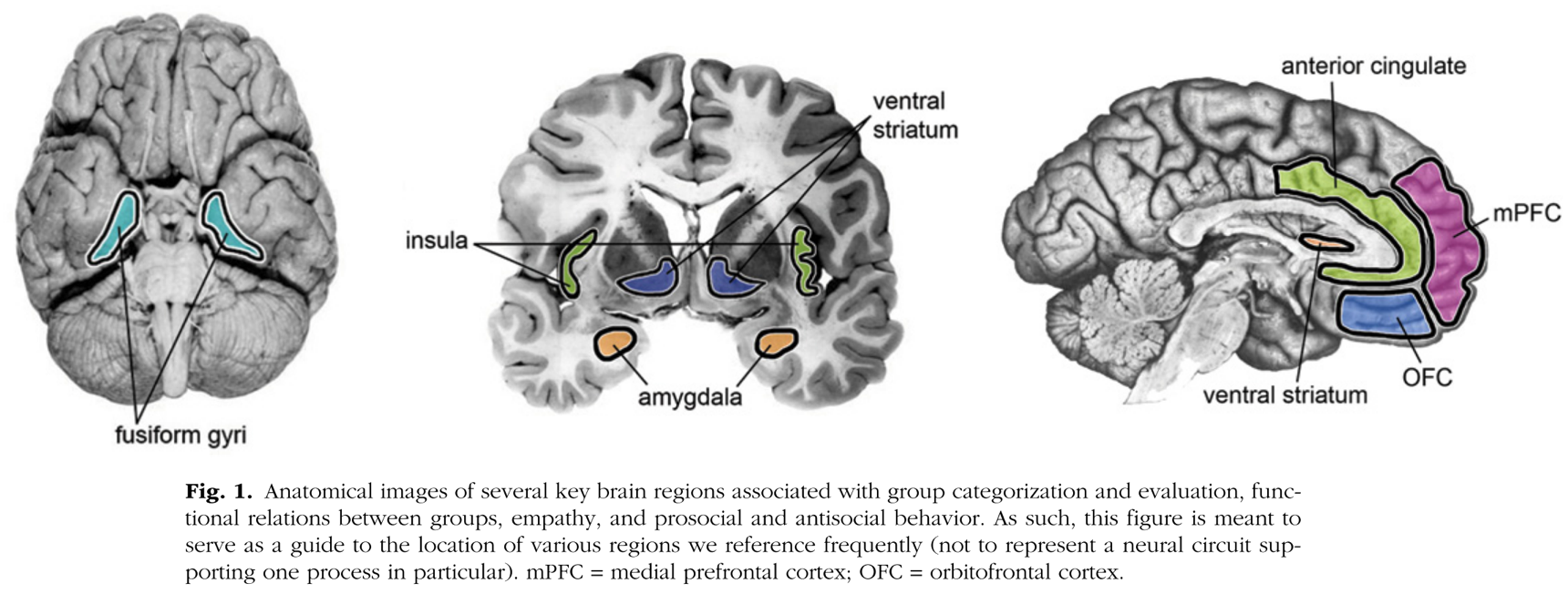
Group identity critically influences social learning. Neuroscience research demonstrates that our brains distinctly respond to individuals identified as part of our group (Cikara and Van Bavel 2014), as revealed through fMRI neural imaging (Figure 1.3). This ability likely evolved because when humans first emerged about two million years ago, it was much more important for survival to be able to rapidly identify whether someone was a friend or foe based on group markers. Although group membership can affect how we respond to information learned from others, group membership itself is quite plastic, meaning who belongs to which group can be rapidly reconfigured. For example, neural signals of race-based group perception was observed to be suppressed and overridden when individuals were in mixed-race groups created by experimenters that competed against other mixed-race groups in an psychological experimental task (Van Bavel, Packer, and Cunningham 2008).
Studies further show that group identity can strongly influence behavioral choices. For instance, experimental evidence reveals people resist adopting beneficial behaviors if associated with opposing political identities (Ehret et al. 2022), emphasizing how identity can create substantial barriers to sustainability. This general effect of group membership interfering with learning is called outgroup aversion (Smaldino et al. 2017).
Identity, homophily, and social networks shape viral sustainability
Social structure can significantly impact behavioral diffusion, especially in core-periphery configurations. Core-periphery networks emerge as a response to risk and uncertainty, e.g., in food sharing networks (Ready and Power 2018), so they are hypothesized to also be important in climate change adaptation transmission networks (Jones, Ready, and Pisor 2021). Core-periphery networks can be created by setting appropriate group sizes and homophily levels in homophily network models (Turner et al. 2023) or specifying certain connectivity probabilities to the stochastic block matrix algorithm for creating structured random graphs (Rombach et al. 2014; Milzman and Moser 2023). Homophily is the measure of how much more likely an individual is to socially connect within their own group versus with a member of a different group. Homophily can range from -1 to +1, where -1 represents no within-group connections and only between-group connections (i.e., anti-homophily); 0 represents an equal probability of within- and between-group connections, and +1 represents only within-group connections. We will define homophily as either a global or group-level variable, though homophily could vary individually as well. There are two types of homophily:
- Choice Homophily: Individuals actively prefer interacting with similar others.
- Induced Homophily: Social interactions limited by historical or external conditions like geography, profession, birthplace, etc.
These structural elements can significantly limit the diffusion of sustainable practices from peripheries, like the mangrove management on smaller islands, to central cores. However, as colleagues and I have showed, this core-periphery structure, defined by moderately high majority-group homophily can actually promote the diffusion of adaptations, provided the adaptation is practiced by the minority group (Turner et al. 2023), as is the case for mangrove forest management or prescribed burns.
We don’t observe “opinions”: Why opinion influence is different from learning behaviors
Opinions are not behaviors. They cannot be directly observed, only inferred from behavior. A person planting mangroves or conducting a prescribed burn produces a visible, specific, measurable action. An “opinion” is only constructed in relation to some prompt, like survey responses that political scientists use to poll the electorate on policies and politicians (Zaller and Feldman 1992). Cognitive scientists and psychologists developed other ways to access peoples’ opinions, such as through the timing of keypresses to reveal racial prejudice in an implicit bias test (Greenwald et al. 2009), or using computational linguistic analysis of sentiment analysis (Cody et al. 2015).
Political polarization, when partisans radicalize, makes institutions freeze. Sustainability needs strong institutions to ensure basic needs are met and basic human rights are protected (see bottom row in Figure 1.2). To make things worse, polarization hampers sustainability debates, actively obscuring moderate, win-win solutions and elevating partisan policies.
Indigenous practices we reviewed seem to be ignored at least partly because polarized opinions prevent their consideration and adoption. The same holds for coastal mangrove restoration, renewable energy policy, basic conservation, and in numerous other sustainability problems. People can be—and often are—openly hostile to sustainability for reasons that have little to do with evidence or experience. If opinions are the supposed bridge between psychology and large-scale social shifts, then building strategies on flawed opinion science is like trying to engineer a suspension bridge without knowing how steel bends.
Models and measurements of opinion change
Opinion science needs, but currently lacks, a tight integration of theoretical and computational modeling and experimental design. Here I’ll explain what we need and how theory, modeling, and measurement complement one another through a case study applied to group polarization, which we expand on in more detail in the opinion change post in the Lecture Notes, soon to be another chapter in this online book.
Models
On the modeling side, frameworks like DeGroot’s consensus model or Macy’s Hopfield adaptations generate elegant dynamics of attraction, repulsion, or indifference. But these are mechanisms acting on theoretical constructs, not on directly measurable behaviors. On the measurement side, researchers routinely treat ordinal data—Likert scales of “strongly agree” to “strongly disagree”—as if they were continuous. This sleight of hand allows ANOVAs and regressions to spit out “effects” that may be nothing more than statistical artifacts. Replications don’t fix this; they repeat the same errors. What we call “opinion change” is too often a reflection of our instruments, not of anything happening in people’s minds.
Discussion
Let’s close this chapter by reviewing the dimensions of evaluating the metaphor of viral sustainability to describe the kind of self-sustaining diffusion we’re after. It’s worth unpacking this metaphor.
Viral here is intended to capture the familiar self-sustaining diffusion of fashions and fads. Friends and associates tell one another about what they’re up to and how it’s going. Sometimes they try out what each other are doing then keep doing it because it works for them. If this happens again and again over time, and more people are starting to do something more frequently than people are stopping doing it. The similarity of this process to the spread of pathogens in epidemiology is exactly where the term viral, in the parlance of our times, with apparently wide shared agreement about its meaning. Viruses and other pathogens spread when people interact, while also sometimes rapidly evolving to evade our efforts to stop them.
Airoldi, Edoardo M., and Nicholas A. Christakis. 2024.
“Induction of social contagion for diverse outcomes in structured experiments in isolated villages.” Science 384 (6695).
https://doi.org/10.1126/science.adi5147.
Alongi, Daniel M. 2002.
“Present state and future of the world’s mangrove forests.” Environmental Conservation 29 (3): 331–49.
https://doi.org/10.1017/S0376892902000231.
Brooks, Jeremy S., Timothy M. Waring, Monique Borgerhoff Mulder, and Peter J. Richerson. 2018.
“Applying cultural evolution to sustainability challenges: an introduction to the special issue.” Sustainability Science 13 (1): 1–8.
https://doi.org/10.1007/s11625-017-0516-3.
Cibelli, Emily, Yang Xu, Joseph L. Austerweil, Thomas L. Griffiths, and Terry Regier. 2016.
“The Sapir-Whorf hypothesis and probabilistic inference: Evidence from the domain of color.” PLoS ONE 11 (7): 1–28.
https://doi.org/10.1371/journal.pone.0158725.
Cikara, Mina, and Jay J. Van Bavel. 2014.
“The Neuroscience of Intergroup Relations: An Integrative Review.” Perspectives on Psychological Science 9 (3): 245–74.
https://doi.org/10.1177/1745691614527464.
Clydesdale, Heather, and Kajal Shah. 2023.
“Microfinance and Women: The Micro-Mystique.” Asia Society: Education.
https://asiasociety.org/education/microfinance-and-women-micro-mystique.
Cody, Emily M., Andrew J. Reagan, Lewis Mitchell, Peter Sheridan Dodds, Christopher M. Danforth, and M Twain. 2015.
“Climate Change Sentiment on Twitter: An Unsolicited Public Opinion Poll.” Edited by Sune Lehmann.
PLOS ONE 10 (8): e0136092.
https://doi.org/10.1371/journal.pone.0136092.
Ehret, Sönke, Sara M. Constantino, Elke U. Weber, Charles Efferson, and Sonja Vogt. 2022.
“Group identities can undermine social tipping after intervention.” Nature Human Behaviour.
https://doi.org/10.1038/s41562-022-01440-5.
Eisenberg, Cristina, Christopher L. Anderson, Adam Collingwood, Robert Sissons, Christopher J. Dunn, Garrett W. Meigs, Dave E. Hibbs, et al. 2019.
“Out of the Ashes: Ecological Resilience to Extreme Wildfire, Prescribed Burns, and Indigenous Burning in Ecosystems.” Frontiers in Ecology and Evolution 7 (November): 1–12.
https://doi.org/10.3389/fevo.2019.00436.
Greenwald, Anthony G., T. Andrew Poehlman, Eric Luis Uhlmann, and Mahzarin R. Banaji. 2009.
“Understanding and using the Implicit Association Test: III. Meta-analysis of predictive validity.” Journal of Personality and Social Psychology 97 (1): 17–41.
https://doi.org/10.1037/a0015575.
Henrich, Joseph. 2015. The secret of our success. Princeton University Press.
Jones, James Holland, Elspeth Ready, and Anne C. Pisor. 2021.
“Want climate-change adaptation? Evolutionary theory can help.” American Journal of Human Biology 33 (4): 1–17.
https://doi.org/10.1002/ajhb.23539.
Kolden, Crystal A. 2019.
“We’re not doing enough prescribed fire in the western united states to mitigate wildfire risk.” Fire 2 (2): 1–10.
https://doi.org/10.3390/fire2020030.
Lakoff, George, and Mark Johnson. 1980.
Metaphors We Live By. Chicago: University of Chicago Press.
Liddell, Torrin M., and John K. Kruschke. 2018.
“Analyzing ordinal data with metric models: What could possibly go wrong?” Journal of Experimental Social Psychology 79: 328–48.
https://doi.org/10.1016/j.jesp.2018.08.009.
McNamara, Karen E., Rachel Clissold, Ross Westoby, Annah E. Piggott-McKellar, Roselyn Kumar, Tahlia Clarke, Frances Namoumou, et al. 2020.
“An assessment of community-based adaptation initiatives in the Pacific Islands.” Nature Climate Change 10 (7): 628–39.
https://doi.org/10.1038/s41558-020-0813-1.
Milzman, Jesse, and Cody Moser. 2023.
“Decentralized core-periphery structure in social networks accelerates cultural innovation in agent-based model.” In
Proc. Ofthe 22nd International Conference on Autonomous Agents and Multiagent Sys- Tems (AAMAS 2023).
http://arxiv.org/abs/2302.12121.
Nalau, Johanna, Susanne Becken, Johanna Schliephack, Meg Parsons, Cilla Brown, and Brendan Mackey. 2018.
“The role of indigenous and traditional knowledge in ecosystem-based adaptation: A review of the literature and case studies from the Pacific Islands.” Weather, Climate, and Society 10 (4): 851–65.
https://doi.org/10.1175/WCAS-D-18-0032.1.
O’Connor, Cailin, and James Owen Weatherall. 2018.
“Scientific polarization.” European Journal for Philosophy of Science 8 (3): 855–75.
https://doi.org/10.1007/s13194-018-0213-9.
Pearson, Jasmine, Karen E. McNamara, and Patrick D. Nunn. 2020.
iTaukei Ways of Knowing and Managing Mangroves for Ecosystem-Based Adaptation. Springer International Publishing.
https://doi.org/10.1007/978-3-030-40552-6_6.
Piggott-McKellar, Annah E, Patrick D Nunn, Karen E McNamara, and Seci T Sekinini. 2020.
“Dam(n) Seawalls: A Case of Climate Change Maladaptation in Fiji.” In
Managing Climate Change Adaptation in the Pacific Region, edited by W. Leal Filho, 69–84. Springer.
https://doi.org/10.1007/978-3-030-40552-6.
Ready, Elspeth, and Eleanor A. Power. 2018.
“Why wage earners hunt: Food sharing, social structure, and influence in an arctic mixed economy.” Current Anthropology 59 (1): 74–97.
https://doi.org/10.1086/696018.
Regier, Terry, and Yang Xu. 2017.
“The Sapir-Whorf hypothesis and inference under uncertainty.” Wiley Interdisciplinary Reviews: Cognitive Science 8 (6): 1–11.
https://doi.org/10.1002/wcs.1440.
Rombach, M. Puck, Mason A. Porter, James H. Fowler, and Peter J. Mucha. 2014.
“Core-periphery structure in networks.” SIAM Journal on Applied Mathematics 74 (1): 167–90.
https://doi.org/10.1137/120881683.
Smaldino, Paul E, Marco A Janssen, Vicken Hillis, Jenna Bednar, Paul E Smaldino, Marco A Janssen, Vicken Hillis, and Jenna Bednar. 2017.
“Adoption as a social marker: Innovation diffusion with outgroup aversion.” The Journal of Mathematical Sociology 41 (1): 26–45.
https://doi.org/10.1080/0022250X.2016.1250083.
Swette, Briana, Lynn Huntsinger, and Eric F. Lambin. 2023.
“Collaboration in a polarized context: lessons from public forest governance in the American West.” Ecology and Society 28 (1).
https://doi.org/10.5751/ES-13958-280129.
Turner, Matthew A., Alyson L. Singleton, Mallory J. Harris, Ian Harryman, Cesar Augusto Lopez, Ronan Forde Arthur, Caroline Muraida, and James Holland Jones. 2023.
“Minority-group incubators and majority-group reservoirs support the diffusion of climate change adaptations.” Philosophical Transactions of the Royal Society B: Biological Sciences 378 (1889).
https://doi.org/10.1098/rstb.2022.0401.
Turner, Matthew A., and Paul E. Smaldino. 2022.
“Mechanistic Modeling for the Masses - commentary on Yarkoni, "The generalizability crisis".” Behavioral and Brain Sciences 45 (E33).
https://doi.org/10.1017/S0140525X2100039X.
Van Bavel, Jay J, Dominic J Packer, and William A Cunningham. 2008. “The Neural Substrates of In-Group Bias.” Psychological Science 19 (11): 1131–39.
Witt, Alexandra, Wataru Toyokawa, Kevin N. Lala, Wolfgang Gaissmaier, and Charley M. Wu. 2024.
“Humans flexibly integrate social information despite interindividual differences in reward.” Proceedings of the National Academy of Sciences 121 (39).
https://doi.org/10.1073/pnas.2404928121/-/DCSupplemental.Published.
Zaller, John, and Stanley Feldman. 1992.
“A Simple Theory of the Survey Response: Answering Questions versus Revealing Preferences.” American Journal of Political Science 36 (3): 579.
https://doi.org/10.2307/2111583.
1.1 Social Science for Sustainability
Social science is immensely broad and complex comprised of numerous traditional academic disciplines in their entirety, such as anthropology and sociology, with contributions from several other traditional disciplines, including cognitive science, engineering, and physics. We use the problem of promoting sustainable practices via interventions to structure this work. Sustainability interventions are eductaion campaigns to induce the diffusion of certain adaptive, sustainable behaviors, such as in public health (Airoldi and Christakis 2024), microfinance to support gender equality at work, home, and everywhere (O’Connor and Weatherall 2018; Clydesdale and Shah 2023), and climate change adaptation via ecosystem protection (Brooks et al. 2018; McNamara et al. 2020). Following the UN SDGs, we see that this is quite a broad range of potential behaviors, which is actually a good thing. It means that our conclusions could apply to a broad range of application domains.
On reflection, social science for sustainability needs a science of how adaptive, sustainable behaviors, opinions, and other socially-transmitted items diffuse from person to person, throughout a population, over time. I don’t know for sure, but it seems like this may be the fundamental problem in social science, broadly understood. The puzzle of adaptation frames the overarching question of designing interventions: how best to jump-start a self-sustaining process diffusing adaptive sustainable behaviors?
Computational social science is the use of mathematics and computers to understand and model the mechanisms underlying social diffusion phenomena, such as the adoption of sustainable practices or rising political extremism, and statistically analyze collective behavior data. We start here and for the first chapters of the book developing formal and generative models of promoting widespread behavior change. When we come to opinion change, we arrive at a natural transition point where theory necessarily meets practice to understand how to properly measure opinion change in the real world, which requires statistical inference since opinions are not directly measurable. We apply our techniques to show that
Computational social science is a cognitive gadget to help us use social science theory for reasoning about the effect of different cognitive capacities (e.g., adaptive social learning), social processes (e.g., rising extremism), and social and natural environment constraints (e.g., social networks, wildfire risk). Too often in the history of social science, social science theory is not presented mathematically, with squishy verbal explanations of theories and their consequences instead of concrete, rigorous mathematical or computational statements, where rigorous means they are theoretically true under a set of explicitly-specified assumptions. This means that mechanisms have tended to be only vaguely specified, and changes in assumptions cannot be quantitatively, let alone systematically, explored (Turner and Smaldino 2022).
The UN Sustainable Development Goals help us focus and organize our work by providing concrete goals for evaluating progress towards sustainable development for all Figure 1.2. These goals include targets for institutional development that promotes basic conditions for human thriving (justice, equality, education, public health, and no poverty) so as to assemble and enable a critical mass of people to participate bringing about sustainable development. People cannot participate in sustainability if they suffer in poverty, from illness, or subjugation by authoritarians–all but the most zealous environmental defenders will fight on when these basic needs are unmet. Since progress has been slower than necessary.
Sustainability, then, has several different dimensions, all of which contribute to climate action and environmental protection. I have organized these goals into the VIBE system to guide sustainability promotion where Vibrant Institutions meet the Basic needs, including Environmental and Ecological protection. The 17 goals and how they each help catch a VIBE are illustrated in Figure 1.2.
Organizing and connecting our work to has two benefits. First, it helps us identify which cognitive and social factors are at work in different sustainability foci. Second, it expands the corpus of existing research on which we draw to consolidate our social and cognitive theories of behavior change that we will apply to sustainability interventions. While many of us in computational social science know our work is important as basic science partly because we are confident it can apply to real-world problems, it is not clear how. Part of this problem seems to stem from the lack of a clear goal for this science beyond evaluating alternative theories of social behavior.
Sustainability serves as a sort of never-ending Manhattan Project for social scientists, an ethically praiseworthy pursuit that will provide a selection pressure on social science frameworks or theories that theory-comparison goals cannot: our social science frameworks, theories, and models should be maximally useful to the long-term study of sustainability. That means simulations should be designed so the model parameters and outcome measures are observable and could reasonably be measured in the real-world. It means flexibly adopting different assumptions in different cases, possibly sampling from different theories that, in a different context, might make contrary predictions.